CELEBRATING 325 YEARS OF IPSWICH UNITARIAN MEETING HOUSE Friday 17th May 2024
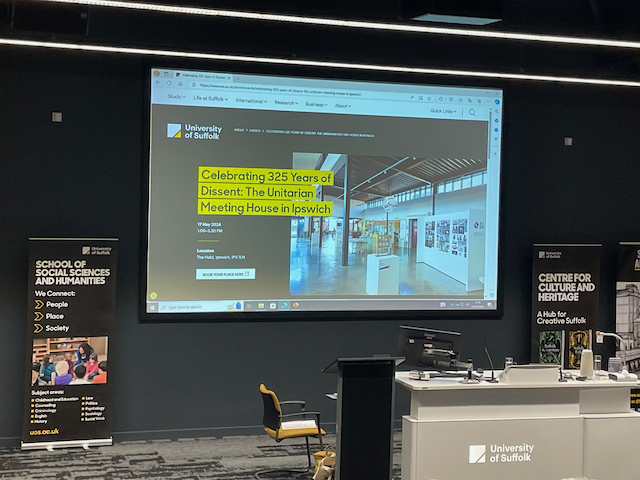
The Social Sciences and Humanities Centre at the University of Suffolk made the 325thanniversary of the building of the Ipswich Unitarian Meeting House the subject of the latest in their series of lectures about the history of Ipswich. The members and Friends of IUMH were delighted to join in the special day on Friday 17th May. In the morning over 60 people called in to look around the Meeting House and learn more about its history from church members, volunteers and Ipswich Town Guide Margaret Hancock.
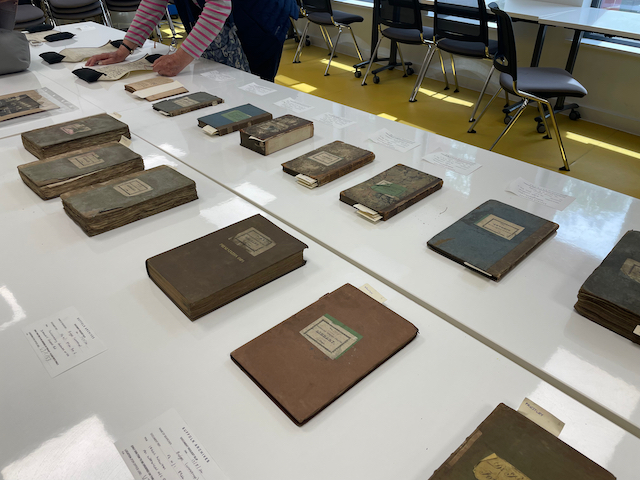
In the afternoon The Hold, home of the Suffolk Records Office, was the location for two well-attended lectures, and the many documents about the early years of the Meeting House that are stored there were also on show.
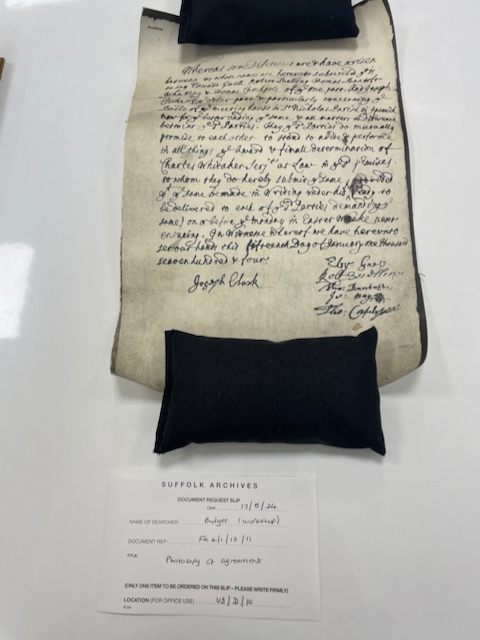
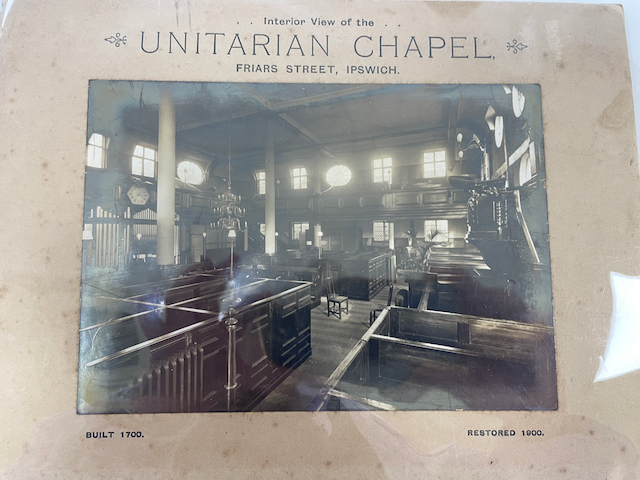
The first lecture was given by Rev Cliff Reed, Minister Emeritus, and previous Minister at IUMH, who spoke about the history of the building, followed by Dr Elizabeth Kingston-Harrison who wrote her doctorate on Joseph Priestly, the famous scientist, philosopher, free-thinker and Unitarian.
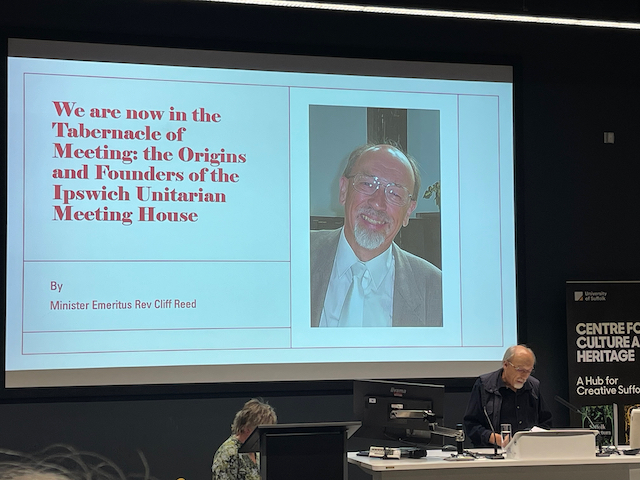
We are now in the Tabernacle of Meeting: The Origins and Founders of the Ipswich Unitarian Meeting House’ and was given by Minister Emeritus Cliff Reed.
Cliff began by explaining the historical context of the building on which work to erect it started in 1699.
In 1661, after the restoration of the monarchy at the time of King Charles II, the Clarendon Code/Corporation Act re-established the supremacy of the Anglican Church but ended toleration of the increasingly strong movement of dissenters and non-conformists. In the “Great Ejection’ a fifth of clergymen, over 2,000 clergy across the country, lost their livings because they wouldn’t agree to abide by Church of England rules of what and how to preach. They were also banned from preaching within five miles, yet many lay people followed them and began to worship in secret. In 1664 the law also said that no more than five unrelated people could meet together but by 1672 an ‘Indulgence’ eased that ruling and the non-Conformists started to meet in Silent Street and part of that congregation built a Congregational Church in Tackett Street.
The Meeting House was built in its current location, concealed from public view, behind the medieval streets of shops and accessed through a passageway in St Nicholas Street.
Building of the Meeting House started in 1699 with six members signing the contract, two ‘gentlemen, a beer brewer, a linen weaver and a clothier. With boxed pews on four sides (rearranged in 1900), the main entrance was on the east wall, and the door has a spyhole included so that those in fear of violence because of their beliefs, from the town’s Anglican church-goers, could check the coast was clear before leaving.
The first service was held in the Meeting House on 26th May 1700 and John Fairfax was the preacher and complimented the spacious building. that, with no symbols of idolatry, was an impressive 60’ by 50’ with a double roof, timber floor and beams, clear glass windows, high carved pulpit, galleries , and chandelier,…all of which can still be seen today.
‘Undue levity’ was prohibited in the Meeting House and there was no organ in the building in the early days as no singing was included in the services
Extensive research by Cliff, including records such as wills, revealed much about the people who were the first worshippers at the Meeting House and who’s dedication and commitment created such a simple but impressive place of worship.
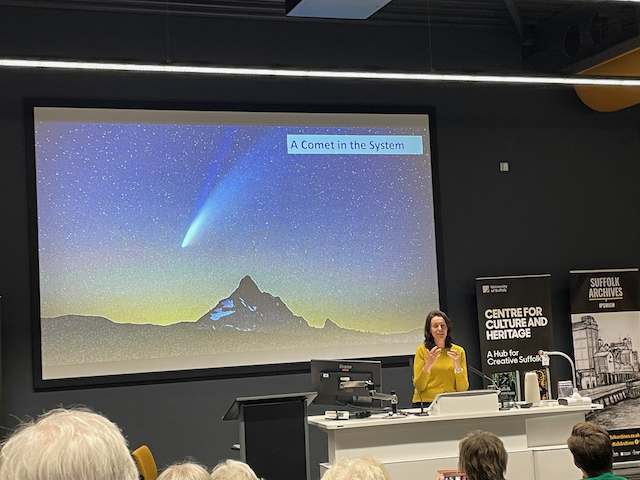
A Comet in the System: Joseph Priestley and the Emergence of Rational Dissent in the Eighteenth Century’ was presented by Dr Elizabeth Kingston Harrison.
Elizabeth began by confirming that early Dissenters were ‘brave, optimistic, unique and real’. She explained that as a Historian of Ideas and a Unitarian herself, she is interested in the arc of knowledge and how new ideas emerge …and the impact it has on our lives.
Joseph Priestley (1733-1804) the scientist and philosopher, grew up amongst ‘Old Dissenters’ and was enrolled in a Dissenting College.
She explained that Rational Dissent, a branch of religious non-conformity, is linked to the individual’s conscience. Priestley developed Unitarian ideals and ideas, based on the belief that we were not born with sin, and that Jesus wasn’t needed to save us from sin. God’s grace is freely given, universal salvation is for all, and no-one’s life is chosen or pre-destined. God’s Truth is accessible to everyone and not through clergy: what is needed is social action. The rights of women, men, slaves, children and animals are equal. He needed to break away from his earlier religious teaching from his Calvinist family and found himself focussing on what he could evidence.
Elizabeth told the audience that by unlocking historical facts and changing the system, Priestley was rightly called “A Comet in the System’ – challenging orthodox ideas, and ideas that would emerge both in the system and out of it. She ended by saying that Rational Dissent has affected how our culture looks today.
————————————————————————————————
After the speakers had delivered their lectures, attendees were invited by the Friends of the IUMH to talk to return to the Meeting House for an informal discussion with the speakers – over a glass of Prosecco. It was a pleasant end to an interesting day that reinforced to all the importance of our historic building.
 Friends of the Ipswich Unitarian Meeting House